Sunday, 16 January 2011

meeting: 15.01.11


After experimenting with the expensive torch with used Namak's cheap torch from Robert Dyers which has a 3 LEDs in the head which gave a really nice effect of the light shape we normally get but three over lapping each other.

This image shows an LED that we brought attached to a volt changer power supply secured together with a bit of electrical tape.

After experimenting with the LED torch that we brought online we came to the conclusion that we much preferred the results given from the iphone 4 LED flash light, so we jumped in the van and drove down to Maplins to investigate the kind of LED we were after. After talking with an employee from Maplins we walked away with 3 LEDs at 3mm & 5mm super bright and a 5mm bright blue LED. We had also discussed about using a power supply to power our light source rather than batteries and if we could get cables for the power supply that were discreet as possible and in keeping with the minimal feel of our artwork.


We thought about how our instillation would be viewed at kenetica and how we would ideally like the audience to be able to walk around the piece and view it from above. We soon realised that if people were walking by they could quite possibly miss the amazing effects we were displaying as the organza was as high as the 2.7m high and if we were to have the material hang at a 45 degree the audience would from afar see the effect and still from all sides and above. The material then came back to looking more like a sail, which we then toiled with the idea of introducing ind power in again to play on the theme of turbulence that was first set out by the UKRC group.


We experimented with the artwork projecting horizontally onto a wall or surface and also with silk organza as a surface for our light to reflect onto, the effects were mesmerising but something always Drew us back to projecting upwards onto the celling giving us the easiest to control results, but as we would be exhibiting our artworks in an exhibition space where we would have problems projecting upwards due to light conditions and/or having to block in our space which would totally contradict the feel and effect we were hoping for. So we set out find other ways in which we could still continue to project upwards in the environments we would be facing.

We experimented by suspending the silk organza from the celling from each of its corners and created a hanging mechanism that would allow us to suspend the torch from the celling without it interfering with the silk. We managed this and placed the parabolic mirror directly on the floor below. The effects where great the organza displayed the reflection upon its surface but also allowed the light to pass through it onto the celling above. One thing we did discuss that as we would like to project up it would also be nice for the visitors to the exhibition to be able to see the artwork from the galleries above and this silk organza did exactly that. We left the doors of are basement room open and the light on in the room next door to us to give an ambient light exposure that we might get at Kenetica.

Friday, 14 January 2011

iphone 4: LED


Throughout our testing, researching and experimenting with light sources we always seem to come back to using Apples iphone4 flash light. The results using this LED flash light which can be set to have a constant beam gives us the brightest of results and an incredible amount of depth and detail of our reflection of what we like to calla parabolic star.

We have decided that we could not use the iphone itself in our artwork as it is of a large clumpy size, so we have now set out to research the type of LED the iphone uses as a single LED suspended in our artwork would look a lot more subtle.

http://www.apple.com/iphone/specs.html

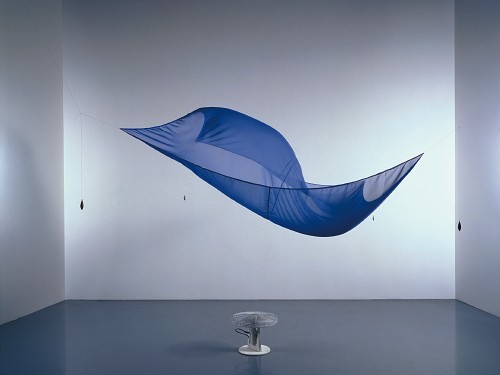
Hans Haacke: Blue Sail

Hans Haacke, 1964-1965, installation. chiffon, oscillating fan, fishing weights, and thread

German artist Hans Haacke has lived and worked in New York since traveling to the U.S. on a Fulbright grant in the early 1960s. Although his early works dealt with natural processes (such as water's thawing and condensation, or the movement of air currents), Haacke is best known as a pioneer of institutional critique.

Many of his works attempt to expose the connections between money, politics, and art — for instance, corporations' financial support of museum exhibitions as a means of whitewashing politically questionable organization policies. For Haacke, the institutions of the art world have too long hidden behind mollifying myths of disinterested beauty and "art for art's sake." His work insists that artists and viewers alike have a responsibility to acknowledge their position on the global stage.

http://www.sfmoma.org/artwork/120791#

Tuesday, 11 January 2011

Meeting: 12.01.11


We discussed and debated how the final look of our exhibition might be, whether to view the piece horizontally or vertically.

We meet with Andrew our tutor and Ray the lead member of the UK Kinetics Research Centre and showed them how far our project had come and the direction we are thinking of taking it.

We decided we would arrange our art work horizontally by suspending the light source from the sides of our exhibition space placing the mirror at ground level possibly suspended and to have a sail like cloth to project the image onto.

I know feel that the project has got to were it needs to be and now we can spend the next couple of weeks refining and polishing the the look and feel of the art work, which is still titled 'Opus Etheres'.

We will next be meeting on Saturday the 15.01.11

Research for next meeting:

- Sails


- kites

- Light Sculptures

- Lasers


- Correspondence between the three objects ( Light, Mirror & Projection screen )

Meeting: 08.01.11

I missed this meeting due to illness.

Progressed made from others at meeting:

Meeting: 05.01.11

Wednesday, 22 December 2010

Equipement for next Meeting: 22.12.10

Next Meeting: 29.12.10

- Fishing Line

- Fan (i'm bringing)

- Stick on hocks

- Silk (sally has)

- Black cloth

Meeting: 22.12.10

We discussed ways in which we could potentially display our light sculptures in the exhibition space.

We did not do further experiments today, but we decided on the types of equipment we could bring in for our next meeting on the 29.12.10 and ways we could use equipment.

Monday, 20 December 2010

Opus Etherea meaning: 20.12.10

Meeting Cancelled: 20.12.10

Saturday the 18th of December meeting cancelled due to snow, lots of it!

Final Blurb: 20.12.10

Name: "Opus Etherea"

Blurb:

“An abstract interpretation of flow visualization and specular reflection, which seeks to illuminate hidden natural phenomena that exist all around us.

'Unseen' mathematical wonders and physics of nature; the creation of an aura of ephemeral light, the formation of furls and vortex's in air on a predetermined atmospheric journey, as it 'migrates' or 'infuses' within the dimensions of our natural space, as it progresses on an infinite passage through time.

Within the quiet movement of a breath, a gentle motion or gesture, there exists a hidden complexity in the universally shared perception of simplicity or 'nothingness' observed in air, water and atmosphere – and yet, this is how all life is supported and sustained. How our slightest or fleeting movements impact on a fragile world, and how our existence is based on the precision and perfection of the constant interchange of substance and matter, such as the intricate process of the oxygenation of our blood through our lungs and heart. These apparently simple, yet incomprehensibly complex natural occurrences are potentially breathtakingly beautiful. The work intends to transcend preconceived perceptions of time and space and convey the immense hidden true significance and importance that belies the enigma of the forces of life itself.”

Ephemeral: 20.12.10

Ephemeral things (from Greek εφήμερος - ephemeros, literally "lasting only one day"[1]) are transitory, existing only briefly. Typically the term is used to describe objects found in nature, although it can describe a wide range of things.

Thursday, 16 December 2010

Kenetica Blurb & Publicity Pics: 16.12.10

Immos Version:

Name: "Air-Phemeral" (a word play on "Air" and "Ephemeral")

Blurb:

"We are constantly surrounded by slight, fleeting movements in the space we inhabit which consists of the air we breathe in and out, essential to our survival yet we do not experience it consciously except when in a different state to the one we are accustomed to. We can sense its temperature and humidity, we can hear its vibrations through sound but we cannot really grasp it with our bare eyes. By creating a new spacial dimension through light, distortion and reflections of air particles the spectator is invited to discover and explore an unseen, mysterious, ephemeral world which is around us at all times yet we think of as a never changing constant in our lives. Could we consciously transcend into this other dimension to gain some deeper understanding of where we are and how our slightest movements impacts on a fragile world which consists of an amazingly thin blue layer of gas on a small planet no larger than a minuscule dot in an endless universe?"

Sally's Version:

Installation, mixed media and projection
Artists: Hadjer Ben, Immo Blaese, Sally Butterfield, Namak Khsh, Georgina Trias, Marcin Wysocki, (MA Students at TVU)

An abstract interpretation of flow visualisation, which seeks to illuminate hidden natural phenomena that exist all around us.
The 'unseen' mathematical wonders and physics of nature; patterns created in swirling smoke, or the way air and water create unseen furls and vortex's on a predetermined atmospheric journey, as it 'migrates' or 'infuses' with another substance, as it progresses on it's infinite journey. Within the quiet movement of a breath, a gentle motion or gesture, which is taken for granted by all of us, exists this hidden complexity in a universally shared perception of simplicity or 'nothingness' observed in air, water and atmosphere – and yet, this is how 'all' life is supported and sustained. Our existence throughout time is based on the ability of the constant interchange of substance and matter, such as the intricate and complex process of the oxygenation of our blood, which is then distributed throughout our bodies, via our heart to our vital organs, which occurs without us even being conscious of it.

These apparently simple, yet incomprehensibly complex natural occurrences are potentially breathtakingly beautiful. The work intends to capture and convey the immense hidden true significance and importance that belies the enigma of the forces of life itself.

UKRC Meeting: 15.12.10

Hi all, just to give you a quick update, Namak and myself have updated on our progress at the UKRC Kinetica meeting and we have had some very positive response on our thoughts and experiments from last Saturday. This also from people which have not heard from or been involved in the project, which I think is a good sign.- Next we need to get some images, an exhibit name and blurb over to Ray by Friday.- He likes those black and white ones very much (and so do we) so I guess best if we created a selection of our 3 to 4 favourite images.- With regards to the title and blurb I am going to set up a discussion thread shortly to get this going.

P3 High Definition: 15.12.10

Ambika P3
Terry Flaxton: High Resolution Moving Image Works
Date: 9 December 2010 12.00am - 19 December 2010 12.00am
Location: Ambika P3, 35 Marylebone Road, NW1 5LS

The exhibition will feature 12 High Definition works from single screen to installation and represents one of the largest gatherings of high definition display, yet made in the UK (there will be six 20 foot by 10 foot displays). Four major installation pieces will also be showcased including the acclaimed In Other People’s Skins. This exhibition is the culmination of three year’s work and investigation, and perfectly showcases the nature of the high definition medium through the innovative projection of Terry’s works.


http://www.westminster.ac.uk/schools/architecture/p3

http://www.apengine.org/2010/12/terry-flaxton-high-resolution-moving-image-works/

Sunday, 12 December 2010

Schlieren Experiment Diagram: 12.12.10


This diagram shows the layout we used for our latest results. We feel that by having the mirror laying on a table top we were able to get clearer images than when we used a clamp vertically. We think this is because the mirror is acrylic and flexes thus giving us inconsistent results. A glass parabolic mirror should have been purchased originally to insure we could gain the best results from the start.

Yellow Schlieren effect video: 12.12.10


This video captured is the most significant result we have had so far in our investigation into the Schlieren effect. The video shows the light projection from the parabolic mirror onto the ceiling above with a shadow of a hand holding the heat source. In the reflection you can see the Schlieren effect, which displays heat particles rising from the lighter and above. The image revels a lot more than what the naked eye can see by looking directly at the lighter. Looking at the projection on the ceiling revels the invisible with the use of a parabolic mirror giving a bubbling effect of what looks like heat emitting from the lighter.

Parabola Light Sculpture Experiment: 12.12.10

Parabola Light Sculpture Experiment from georgina Trias on Vimeo.

Illustrated Setup: 11.12.10

Schliern effect videos: 11.12.10

http://www.facebook.com/video/video.php?v=474696671695&oid=152742014764486

Shimmering yellow Schlieren

http://www.facebook.com/video/video.php?v=474682806695&oid=152742014764486

Schlieren Blue filter