Showing posts with label Wind. Show all posts

Friday, 14 January 2011

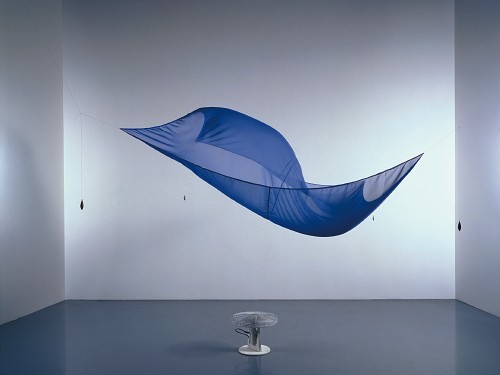
Hans Haacke: Blue Sail

Hans Haacke, 1964-1965, installation. chiffon, oscillating fan, fishing weights, and thread

German artist Hans Haacke has lived and worked in New York since traveling to the U.S. on a Fulbright grant in the early 1960s. Although his early works dealt with natural processes (such as water's thawing and condensation, or the movement of air currents), Haacke is best known as a pioneer of institutional critique.

Many of his works attempt to expose the connections between money, politics, and art — for instance, corporations' financial support of museum exhibitions as a means of whitewashing politically questionable organization policies. For Haacke, the institutions of the art world have too long hidden behind mollifying myths of disinterested beauty and "art for art's sake." His work insists that artists and viewers alike have a responsibility to acknowledge their position on the global stage.

http://www.sfmoma.org/artwork/120791#

Monday, 8 November 2010

Wind Forecast: 08.11.10


The Met Office website allows you to enter either a location, region or postcode to give you wind speed and direction.

http://www.metoffice.gov.uk/weather/uk/se/solent_latest_wind.html

Beaufort: 08.11.10


http://en.wikipedia.org/wiki/Beaufort_scale

The Beaufort Scale is an empirical measure for describing wind speed based mainly on observed sea conditions. Its full name is the Beaufort Wind Force Scale.

The scale was created in 1806 by Sir Francis Beaufort, an Irish-born British admiral and hydrographer. The scale that carries Beaufort's name had a long and complex evolution, from the previous work of others, to when Beaufort was a top administrator in the Royal Navy in the 1830s. In the early 19th Century, naval officers made regular weather observations, but there was no standard scale and so they could be very subjective - one man's "stiff breeze" might be another's "soft breeze". Beaufort succeeded in standardizing the scale.

Twilight: 08.11.10


A beautiful Installation: Twilight , 2000, photo HeHe. Installation realised with the technical help of Michael Feild and initially conceived with Stephanie Hankey, Marcus Gosling and Manuel Mercadal.

The movement onto a paper propeller triggers a wave of light and sound across the otherwise dark space. The force of the propagated air dynamically determines the sound and light: a very soft blow will gently lead to one image change whilst a harder blow will carry a faster tide of images and light flow.


www.hehe.org

Tuesday, 19 October 2010

Week 4: Anemometer: 19.10.10


Wikipedia: An anemometer is a device for measuring wind speed, and is a common weather station instrument. The term is derived from the Greek word anemos, meaning wind. The first known description of an anemometer was given by Leon Battista Alberti around 1450[1].
Anemometers can be divided into two classes: those that measure the wind's speed, and those that measure the wind's pressure; but as there is a close connection between the pressure and the speed, an anemometer designed for one will give information about both.

Tuesday, 5 October 2010

Week 2: Wind: 05.10.10


A piece for Nokia's Flagship Store project by company Nanika, which sees high-end retail experiences opened in shopping capitals around the world.

One of the overarching concepts with all our work for the Nokia Flagship stores has been to take peoples own content and make something beautiful for them out if it.

This piece, together with SwimmingMessageSystem, is an attempt to bring a bit of nature into the store, the concept of this particular piece being a wind blowing through the store taking messages submitted by users via SMS and flying them across the different landscapes.

In it's original incarnation the landscape is something like a magic forest, but the idea is to also make versions specific to the locations that stores open up, like the wheat field below for the Chicago store.

The piece is implemented as real time software running on anything from 24 to 42 screens, depending on the store layout, providing a seamless canvas.

www.nanikawa.com

Week 2: Blow Up: 05.10.10


Blow Up by Scott Snibbe records, amplifies, and projects human breath into a room-sized field of wind. The installation comprises two devices. The first is a rectangular array of twelve small impellers, which stands on a table on one side of the gallery. This small input device is electronically linked to a large wall of twelve electric fans. The tabletop impellers are spatially and temporally synchronized to the fans in the wall. When a “sender” blows into the first device, “receivers” experience the magnified breathing patterns over their entire bodies. When he stops blowing, the wall continues to play back the most recent breathing pattern, captured in an amplified loop, until someone inspires a new pattern.


www.snibbe.com/projects/interactive/blowup

Week 1: tele-present wind: 05.10.10


This installation by David Bowen consists of a series of 21 x/y tilting devices connected to thin dried plant stalks installed in the gallery and a dried plant stalk connected to an accelerometer installed outdoors. When the wind blows it causes the stalk outside to sway. The accelerometer detects this movement transmitting it in real-time to the grouping of devices in the gallery. Therefore the stalks in the gallery space move in real-time in unison based on the movement of the wind outside.


www.dwbowen.com/telewind.html