Showing posts with label Wikipedia. Show all posts

Friday, 10 December 2010

Camera Obscura: 10.12.10

The camera obscura (Latin; "camera" is a "vaulted chamber/room" + "obscura" means "dark"= "darkened chamber/room") is an optical device that projects an image of its surroundings on a screen. It is used in drawing and for entertainment, and was one of the inventions that led to photography. The device consists of a box or room with a hole in one side. Light from an external scene passes through the hole and strikes a surface inside where it is reproduced, upside-down, but with colour and perspective preserved. The image can be projected onto paper, and can then be traced to produce a highly accurate representation.
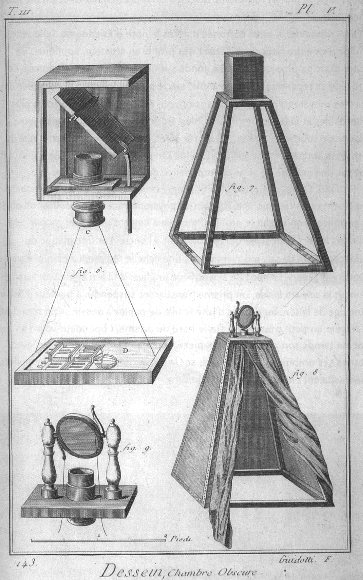
Using mirrors, as in the 18th century overhead version (illustrated in the Discovery and Origins section below), it is possible to project a right-side-up image. Another more portable type is a box with an angled mirror projecting onto tracing paper placed on the glass top, the image being upright as viewed from the back.
As a pinhole is made smaller, the image gets sharper, but the projected image becomes dimmer. With too small a pinhole the sharpness again becomes worse due to diffraction. Some practical camera obscuras use a lens rather than a pinhole because it allows a larger aperture, giving a usable brightness while maintaining focus.

http://en.wikipedia.org/wiki/Camera_obscura

Wednesday, 24 November 2010

Concave Mirror: 24.11.10

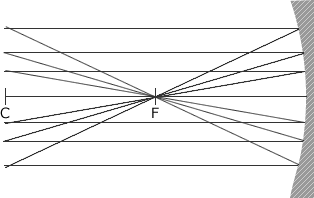
A concave mirror, or converging mirror, has a reflecting surface that bulges inward (away from the incident light). Concave mirrors reflect light inward to one focal point, therefore they are used to focus light. Unlike convex mirrors, concave mirrors show different image types depending on the distance between the object and the mirror.
These mirrors are called "converging" because they tend to collect light that falls on them, refocusing parallel incoming rays toward a focus. This is because the light is reflected at different angles, since the normal to the surface differs with each spot on the mirror.


href="http://www.splung.com/content/sid/4/page/concavemirrors">http://www.splung.com/content/sid/4/page/concavemirrors

http://en.wikipedia.org/wiki/Concave_mirror#Concave_mirrors